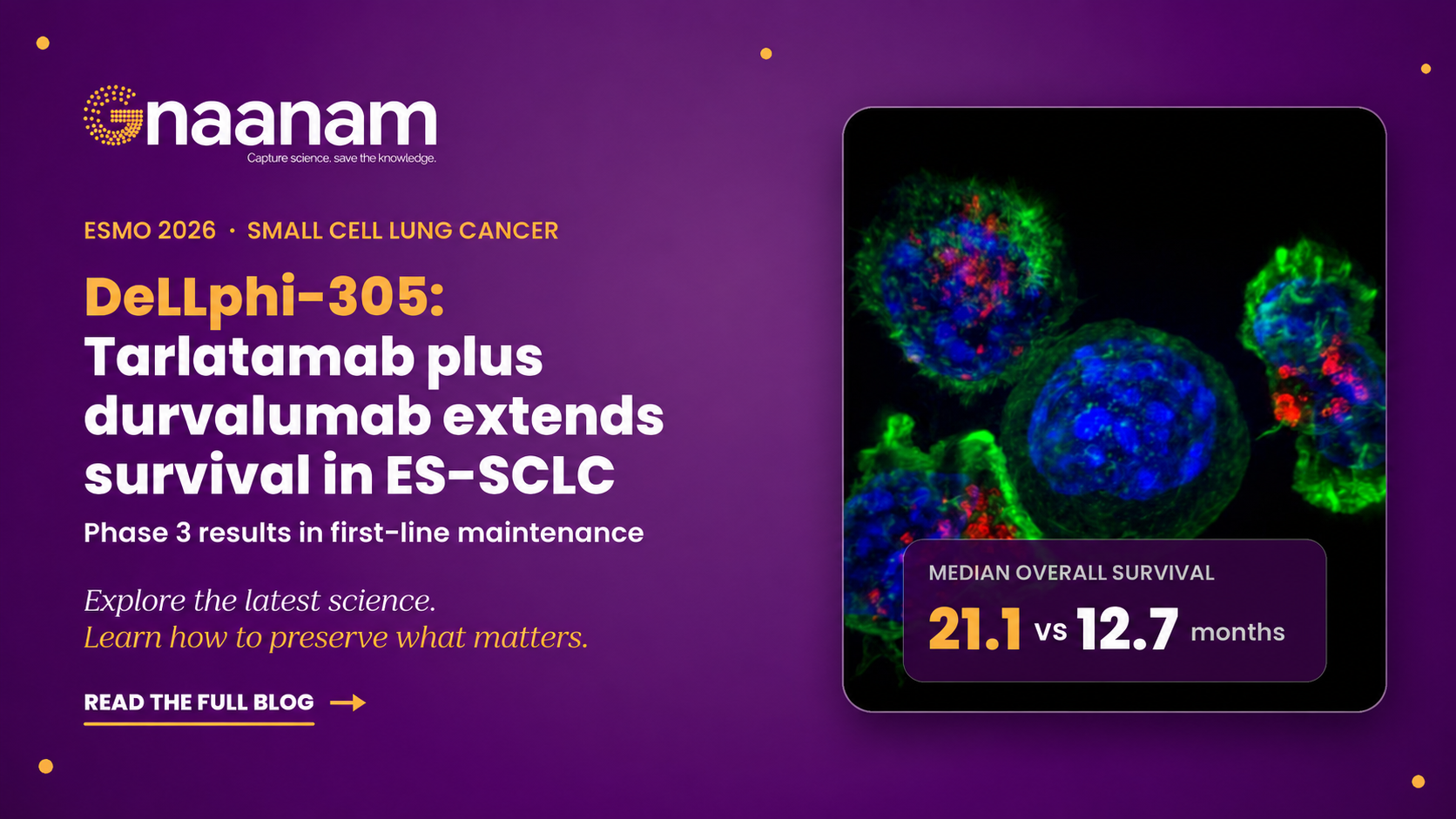
Adding tarlatamab to durvalumab maintenance significantly improved overall survival in extensive-stage small cell lung cancer (ES-SCLC), according to the phase 3 DeLLphi-305 trial. At a planned interim analysis, median overall survival reached 21.1 months with tarlatamab plus durvalumab, against 12.7 months with durvalumab alone (hazard ratio 0.42).
The results were presented in the Presidential Symposium at ESMO Congress 2026 in Madrid on 24 October 2026 and published the same day in The New England Journal of Medicine. For a cancer where median survival from the start of maintenance has sat at about a year, they mark a real step forward. They are also the first phase 3 evidence for moving a DLL3-targeted T-cell engager into first-line care.
Why extensive-stage SCLC needs better options
Small cell lung cancer accounts for about 13–15% of the more than 2.6 million lung cancers diagnosed worldwide each year. It grows quickly, spreads early and very often comes back after initial treatment.
For extensive-stage disease, standard first-line treatment is platinum-etoposide chemotherapy plus an immune checkpoint inhibitor such as durvalumab or atezolizumab, followed by checkpoint-inhibitor maintenance. Even so, median survival from the start of first-line maintenance has been about one year.
Many patients respond to chemoimmunotherapy at first, then relapse. By then, declining performance status and rapid progression often limit what comes next: only about 40% of patients go on to receive second-line treatment. That makes the maintenance window, before the disease progresses, the moment to act. DeLLphi-305 tested exactly that.
What is tarlatamab, and how does it work?
Tarlatamab (Imdelltra, Amgen) is a DLL3-directed bispecific T-cell engager: a molecule that redirects the patient's own T cells towards cancer cells. It binds two targets at once:
- DLL3 (delta-like ligand 3): A protein on the surface of SCLC cells in about 85–96% of patients, with little expression in most normal tissues.
- CD3: Part of the T-cell receptor complex on T cells.
By binding both, tarlatamab holds T cells against DLL3-expressing tumour cells, so the T cells can kill them. This works without the tumour having to present antigens to the immune system in the usual way.
Tarlatamab is already approved in the US for ES-SCLC that has progressed on or after platinum-based chemotherapy. It received accelerated approval in 2024 and traditional approval in November 2025. DeLLphi-305 tested a different strategy: giving it earlier, as first-line maintenance alongside the PD-L1 inhibitor durvalumab.
How was DeLLphi-305 designed?
DeLLphi-305 (NCT06211036) is a global, randomised, open-label phase 3 trial comparing tarlatamab plus durvalumab with durvalumab alone as first-line maintenance.
| Feature | Detail |
|---|---|
| Patients | 563 adults with ES-SCLC whose disease had not progressed after first-line durvalumab plus platinum-etoposide |
| Arms (1:1) | Tarlatamab 10 mg every 2 weeks (after step-up dosing) plus durvalumab 1,500 mg every 4 weeks (n = 282) vs durvalumab alone (n = 281) |
| Brain and liver metastases | Treated or untreated asymptomatic brain metastases allowed; about 20% had brain and about a third had liver metastases at baseline |
| Primary endpoint | Overall survival |
| Secondary endpoints | Progression-free survival, objective response rate, duration of response, safety |
| Analysis | Prespecified interim analysis; data cutoff 7 July 2026; median overall survival follow-up about 16 months |
Treatment continued until progression, unacceptable toxicity or another protocol-defined reason to stop. One detail matters when reading the results: survival was measured from randomisation at the start of maintenance, not from the start of chemotherapy.
The results
The combination significantly improved both overall survival and progression-free survival, and every other efficacy measure reported.
| Endpoint | Tarlatamab + durvalumab | Durvalumab alone | Hazard ratio (95% CI) |
|---|---|---|---|
| Median overall survival | 21.1 months | 12.7 months | 0.42 (0.32–0.54); p < 0.001 |
| Alive at 12 months | 79% | 53% | — |
| Median progression-free survival | 7.4 months | 1.9 months | 0.34 (0.28–0.42); p < 0.001 |
| Progression-free at 12 months | 38% | 10% | — |
| Objective response rate* | 26.4% | 4.1% | p < 0.001 |
| Median duration of response | 12.7 months | 5.6 months | — |
*Among patients with measurable disease at the start of maintenance.
What the numbers mean
- Survival: Median overall survival was 8.4 months longer with the combination. A hazard ratio of 0.42 means a 58% relative reduction in the hazard of death over follow-up. It does not mean each patient's own chance of dying fell by 58%, nor that every patient gained 8.4 months.
- Progression: Median progression-free survival rose almost fourfold, from 1.9 to 7.4 months, a 66% relative reduction in the hazard of progression or death. The control arm's 1.9 months shows how quickly ES-SCLC usually returns after chemotherapy.
- Response: Tumours shrank in more than six times as many patients.
- Time on treatment: At the data cutoff, 43.6% of patients were still on the combination, against 11.4% on durvalumab alone.
For context, the trials that set today's first-line standard, CASPIAN and IMpower133, reported median overall survival of about 12–13 months counted from the first day of chemotherapy. DeLLphi-305's 21.1 months is counted from the start of maintenance, months later. The trials enrolled different patients, so this is a benchmark, not a head-to-head comparison.
Did the benefit hold across subgroups?
The survival benefit was consistent across the prespecified subgroups, including patients with brain metastases (HR 0.49) and liver metastases (HR 0.41). Both groups usually do worse in ES-SCLC, so this is encouraging. The trial was not designed to prove an effect within each subgroup, though, so these results should be read with caution.
Safety
The efficacy gain came with more side effects, including those typical of T-cell engagers. The most feared of these were mostly mild.
| Safety measure | Tarlatamab + durvalumab | Durvalumab alone |
|---|---|---|
| Grade 3+ adverse events, any cause | 46.8% | 40.6% |
| Grade 3+ treatment-related adverse events | 20.9% | 10.8% |
| Stopped treatment because of adverse events | 5.7% | 5.8% |
The first two rows measure different things: all grade 3+ side effects, and only those judged to be caused by treatment. They should not be read interchangeably. Grade 3+ adverse events are also not the same as regulatory-defined serious adverse events.
- Cytokine release syndrome (CRS): 49.6% of patients on the combination. Most cases were grade 1 (41.8%) or grade 2 (7.4%); there was one grade 3 event (0.4%) and no grade 4 or 5 events. CRS is an inflammatory reaction to immune activation and can become serious, so it needs monitoring and prompt management.
- Neurotoxicity (ICANS): About 1.1% of patients, with no grade 3 or higher events.
Tarlatamab needs close attention in the first doses, when CRS and neurological reactions are most likely. Monitoring in trials may differ from what the approved label requires, so clinicians should follow the product label, institutional protocols and local guidance.
What are the limitations?
- It is an interim analysis. With about 16 months of median follow-up, the survival estimates will shift as data mature. Longer follow-up will show how durable the benefit is.
- The trial was open-label. Patients and doctors knew who got what. Overall survival is robust to this, but some other assessments and aspects of care can be influenced.
- Patients were selected after induction. Only people whose disease had not progressed on first-line durvalumab plus chemotherapy could enrol. The results do not apply to those who progress during initial treatment.
- Subgroup results are exploratory. Consistency across subgroups is reassuring, not proof of an effect in each one.
- No head-to-head comparison with other maintenance options. The trial did not compare the combination with other emerging approaches, such as lurbinectedin-containing regimens, so their relative benefits and best sequence remain open questions.
- It is not yet an approved use. Tarlatamab's US approval covers ES-SCLC that has progressed after platinum chemotherapy. Amgen has shared the DeLLphi-305 results with regulators, but first-line maintenance is a separate indication that needs its own review.
What could it mean for practice?
If regulators agree, tarlatamab plus durvalumab could become the standard first-line maintenance for patients who have not progressed after chemoimmunotherapy. Presenting the data, Dr Jacob Sands of Dana-Farber Cancer Institute described the new standard as carboplatin, etoposide and durvalumab, followed by tarlatamab plus durvalumab maintenance.
The case is strong because ES-SCLC moves fast, and many patients never get the chance at later treatment. Giving an effective therapy earlier could extend both disease control and survival. Adopting it would still take work: regulatory approval, CRS monitoring pathways, step-up dosing logistics, patient selection and staff training, especially outside large cancer centres.
How it fits with the other tarlatamab trials
- DeLLphi-304 (phase 3): In previously treated SCLC, tarlatamab beat standard chemotherapy, with median overall survival of 13.6 vs 8.4 months in extended follow-up presented at ESMO 2026.
- DeLLphi-303 (phase 1b): Tested the same combination as maintenance; updated results reported median overall survival of 37.9 months. That was a small, non-randomised study, so it should not be compared directly with DeLLphi-305.
Together, these trials make DLL3 a validated target in SCLC. They also raise the bar for what comes next: antibody-drug conjugates, bispecific checkpoint inhibitors and other T-cell engagers will now be measured against this regimen.
From congress slide to clinic: where Gnaanam comes in
DeLLphi-305 reached most of its audience the way congress data always does: as a handful of slides in a packed hall, one session among thousands of abstracts in five days. Phones went up for the survival curve. Then the forest plot. Then the safety table.
Three weeks later, at a tumour board, someone asks: what was the hazard ratio in patients with brain metastases? The answer is on your phone, somewhere between a poster from day one, a dinner photo and 400 other slides. The question you meant to ask the presenter about step-up dosing is in a different app altogether.
That gap, between capturing the science and finding it again, is what Gnaanam is being built to close.
- Capture once: Snap a slide or poster and Gnaanam files it by congress, day and session.
- Keep the context: Add a note or scan the presenter's badge, and both stay attached to that slide.
- Find it in seconds: Pull up DeLLphi-305's forest plot when you need it, instead of scrolling for twenty minutes.
- Coming next: AI summaries of your captures, and one-tap export to a PDF or presentation for your post-congress report.
Heading to Singapore for the ESMO Asia Congress, 4–6 December 2026? We're attending too, and we'd love to meet oncologists, researchers and Medical Affairs teams. Find us there or write to [email protected].
Join the waitlist at gnaanam.com for early access.
Gnaanam: Capture the science, save the knowledge.
Frequently Asked Questions About DeLLphi-305
Here are answers to common questions about the DeLLphi-305 trial, tarlatamab plus durvalumab, clinical results and implications for first-line ES-SCLC maintenance.
What is DeLLphi-305?
DeLLphi-305 is a global, randomised phase 3 trial of 563 patients with extensive-stage small cell lung cancer (ES-SCLC). It compared tarlatamab plus durvalumab with durvalumab alone as first-line maintenance, after initial durvalumab plus platinum-etoposide chemotherapy.
What were the main results of DeLLphi-305?
Median overall survival was 21.1 months with tarlatamab plus durvalumab versus 12.7 months with durvalumab alone (HR 0.42; 95% CI 0.32–0.54; p < 0.001). Median progression-free survival was 7.4 months versus 1.9 months.
How does tarlatamab work?
Tarlatamab is a DLL3-directed bispecific T-cell engager. It binds DLL3 on small cell lung cancer cells and CD3 on T cells, bringing T cells into contact with tumour cells so they can recognise and kill them.
Is tarlatamab approved for first-line maintenance?
Not yet. As of November 2026, its US approval covers extensive-stage small cell lung cancer that has progressed on or after platinum-based chemotherapy. First-line maintenance is a separate indication that requires regulatory review.
What are the main side effects of tarlatamab plus durvalumab?
Cytokine release syndrome (CRS) occurred in 49.6% of patients receiving the combination, with almost all cases being grade 1 or 2. Grade 3 or higher treatment-related adverse events occurred in 20.9% versus 10.8% with durvalumab alone. Neurotoxicity (ICANS) occurred in about 1.1% of patients.
Where were the DeLLphi-305 results presented?
The DeLLphi-305 results were presented in the Presidential Symposium at ESMO Congress 2026 in Madrid on 24 October 2026, as late-breaking abstract LBA3. The results were published simultaneously in The New England Journal of Medicine.