Two children can receive the exact same diagnosis and still show very different patterns of brain activity. A Stanford-led study suggests traditional diagnostic checklists may be missing part of the biological story.
The Problem With Checklists
Picture two 10-year-olds.
Leo struggles to sit still, interrupts in class, and acts impulsively. Maya is quiet, worries constantly, and finds it hard to concentrate.
Both have trouble focusing in school, yet the reasons behind their struggles look completely different.
Today, attention-deficit/hyperactivity disorder (ADHD) and anxiety disorders are diagnosed primarily through clinical assessments of symptoms, behavior, developmental history, and daily functioning.
The challenge? These conditions frequently overlap. Children with ADHD often experience anxiety, and children with anxiety often struggle with attention and restlessness.
That overlap raises a critical question: Do our diagnostic labels accurately reflect what is happening in the brain?
To find out, a research team led by Stanford Medicine, working with the University of Iowa, turned to artificial intelligence and thousands of brain scans.
Their findings, published in Nature Mental Health in November 2026, reveal that traditional ADHD and anxiety diagnoses do not neatly map onto underlying brain biology. Instead, the researchers uncovered three distinct brain-based patterns, or biotypes, that cut across conventional diagnostic categories.
Inside the Scan: AI Meets 6,000+ Young Brains
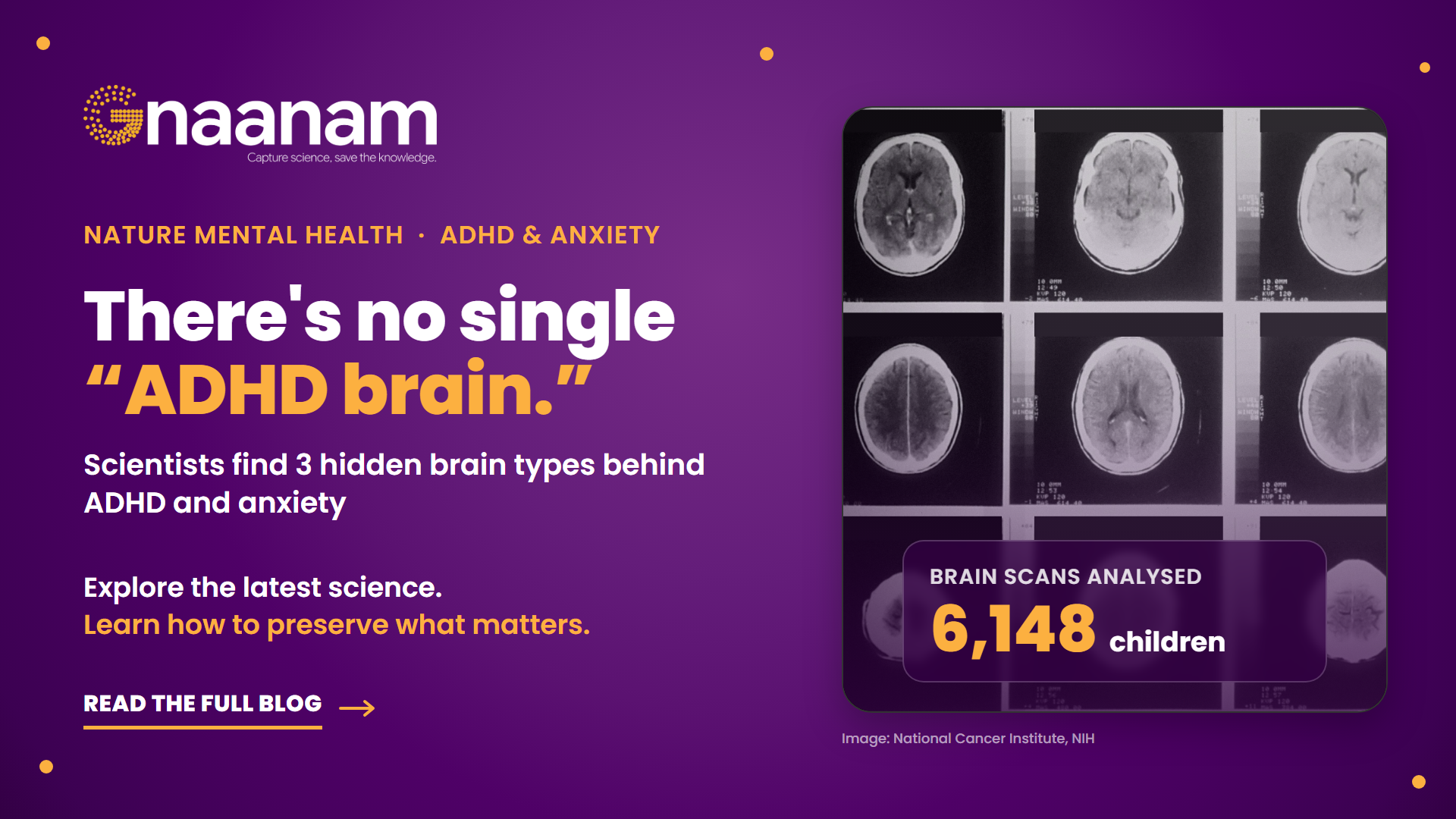
The team analyzed data from the Adolescent Brain Cognitive Development (ABCD) Study, a major U.S. project following more than 11,000 children who enrolled at ages 9 or 10.
Their analysis included 6,148 children across three groups:
- 3,508 children who already had ADHD, anxiety, or both at enrollment.
- 693 children who had neither diagnosis initially but received an ADHD or anxiety diagnosis during follow-up.
- 1,947 children who did not receive either diagnosis, serving as a comparison group.
Each participant underwent functional magnetic resonance imaging (fMRI) and completed cognitive and behavioral assessments. Structural MRI looks at brain anatomy. Resting-state fMRI is different: it tracks patterns of activity and communication between brain regions.
The researchers built a deep-learning AI framework that combined these brain-connectivity maps with behavioral and diagnostic data to uncover patterns that symptoms alone might miss.
To test whether the findings held up outside the ABCD group, they validated their model on an independent sample of 224 children with ADHD, anxiety, or both from the Healthy Brain Network project.
Two Hidden Circuits, Three Distinct Biotypes
The AI distilled the data into two major dimensions of brain–behavior dysfunction, each tied to different brain networks:
- Cognitive-behavioral dysfunction: Linked to differences in cognitive control, impulsivity, and behavioral regulation.
- Emotion-attention dysfunction: Linked to difficulties with emotional regulation and attention.
By mapping how these two dimensions combined, the researchers identified three non-overlapping biotypes:
Externalizing-Disinhibited
- Key traits: Impulsivity, defiance, hostility, aggression, and rule-breaking.
- More common diagnosis: ADHD.
Internalizing-Distressed
- Key traits: Guilt, tension, perfectionism, anxiety-related and depressive symptoms.
- More common diagnosis: Anxiety disorder.
Mixed Dysregulation
- Key traits: Attention difficulties, irritability, self-injury-related symptoms, and physical symptoms (somatic complaints).
- More common diagnosis: ADHD.
Note: These traits reflect statistical differences between groups, not rigid checklists. Not every child in a biotype experiences every associated symptom.
Same Label, Different Brains
None of the three biotypes belonged exclusively to ADHD or anxiety.
Children diagnosed with ADHD could show the Internalizing-Distressed brain pattern, while children diagnosed with anxiety could show the Externalizing-Disinhibited pattern.
In other words, a child like Leo and a child like Maya could have different clinical labels and still share similar underlying brain circuitry. Meanwhile, two children with the same ADHD diagnosis might have very different biological profiles.
The Signal Before the Symptoms
The study's most surprising finding came from the 693 children who had no ADHD or anxiety diagnosis at enrollment but received one later.
Their baseline brain scans already carried connectivity patterns matching the three biotypes. The biological signals were detectable before a formal diagnosis was made.
Co-senior author Dr. Yu Zhang of Stanford Medicine noted that these biotypes could eventually serve as early indicators, potentially supporting timelier intervention.
Moving Beyond Trial-and-Error Treatment
For many families, finding the right treatment for ADHD or anxiety involves months of adjustments: trying a medication or therapy, monitoring side effects, and recalibrating.
Researchers hope brain-based biotypes could one day add an objective layer to those decisions, supporting precision psychiatry in three ways:
- Earlier risk identification: Flagging children who may benefit from closer monitoring or timely evaluation.
- More personalized treatment: Matching therapies to the specific brain networks involved rather than relying solely on symptom checklists.
- Sharper clinical trials: Testing whether specific treatments work better for one biotype than another.
What This Means for Parents Today (And What It Doesn't)
While the findings are encouraging, they are not yet ready for the clinic:
- Research tool, not a clinical test: These biotypes are research classifications, and fMRI is not routinely used to diagnose ADHD or anxiety.
- No individual prediction yet: Detecting group-level patterns before diagnosis does not mean a brain scan can reliably predict whether an individual child will develop ADHD or anxiety.
- Treatment benefits remain unproven: The study did not test whether choosing treatments based on these biotypes improves real-world outcomes.
For parents and clinicians, current diagnostic and treatment guidelines remain unchanged. ADHD and anxiety should continue to be evaluated and managed by qualified healthcare professionals.
The Bigger Picture
Diagnostic checklists gave psychiatry a shared language for symptoms. Studies like this hint at what comes next: a shared language for the brain circuitry underneath them.
By pairing AI with large-scale neuroimaging, researchers are moving closer to understanding not just which label a child receives, but why they are struggling—and how best to help them.
From the Journal to the Congress Floor
Findings like these rarely stay on the page. Over the coming months, the biotype maps, the connectivity patterns and the caveats will be presented at psychiatry, neuroscience and paediatrics congresses, often in a 10-minute talk with one slide that holds the whole story.
That's where the science is easiest to lose. The slide with the three biotypes goes by in seconds, and the network diagram becomes a blurry photo somewhere between a coffee break and a badge selfie. A week later, the detail you wanted to share with your team is gone.
Gnaanam is built for that moment. Capture a slide, a poster or a note during the session, and Gnaanam files it automatically by congress, day and session, so the evidence you saw is still there when it matters.
Join the waitlist at gnaanam.com and be one of the first to use it.
Gnaanam - Capture the Science, Save the Knowledge.
Scientific References
Primary Research
Jiao Y, Tong X, Fonzo GA, Gotlib IH, Pohl KM, Satterthwaite TD, Jiang J, Zhang Y.
Deep learning of brain–behavior dimensions identifies transdiagnostic biotypes in youth with ADHD and anxiety disorders.
Nature Mental Health. 2026;4(11):1686–1700.
DOI: 10.1038/s44220-026-00740-3
Further Reading
Stanford Medicine. November 10, 2026.
Three brain biotypes found in Stanford Medicine-led study of kids with ADHD, anxiety.
Read the Stanford Medicine article
Medical disclaimer: This article is intended for scientific and educational purposes only. It does not constitute medical advice, diagnosis, or treatment recommendations. Individuals with concerns about ADHD or anxiety should consult a qualified healthcare professional.