
A congress costs travel, fees and time away from work. The return depends on what you remember and use afterwards.
Plan before you go
Pick three sessions, two posters and one person to meet.
Capture in one place
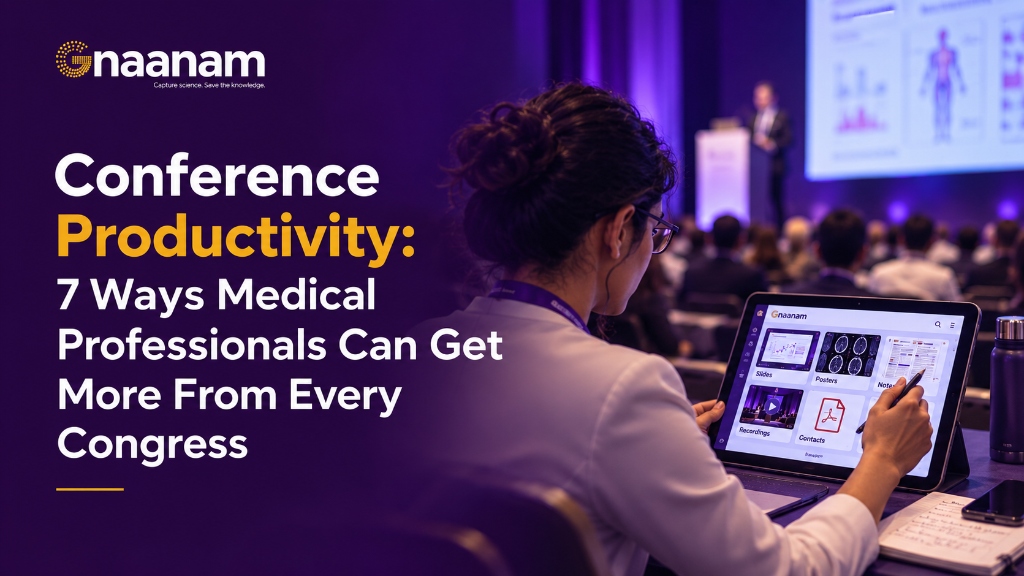
Photos, notes, cards and recordings spread across apps get lost. One of the best conference tools is a single library that holds slides, posters, audio, video, badges and QR-code links.
Let filing happen automatically
Items filed by congress, day and session save hours. See how.
Turn cards and badges into contacts
Snapping them captures name, role, company, email and phone, so there's no retyping.
Review each evening
Check the day's captures and note one takeaway. AI summaries of key takeaways make this faster, and you can ask questions of your captures.
Follow up within a week
Share a talk, folder or library with your team by link or ZIP.
Build a library across years
Four ESMOs and three ASCOs become one searchable knowledge base.
"Event apps handle agendas and networking. Personal conference management tools like Gnaanam handle what you capture."
Event apps handle agendas and networking. Personal conference management tools like Gnaanam handle what you capture. Learn how to organise conference photos and slides.
Frequently asked questions
Key questions on conference productivity, medical knowledge capture, and post-congress workflows.
What is conference productivity for medical professionals?
Conference productivity is the measure of how effectively clinicians and medical affairs teams capture, retain, and apply scientific findings from medical congresses. Gnaanam improves conference productivity by replacing scattered notes and camera rolls with an automated system that organizes slides, posters, and contacts into a searchable workspace.
How do conference productivity tools differ from event management apps?
Event apps like Whova or Swapcard focus on venue logistics, floor plans, and organizer notifications. In contrast, Gnaanam is a personal conference productivity tool built specifically for attendees to capture, organize, and query scientific knowledge long after the event has concluded.
What is the 3-2-1 strategy for planning medical conference attendance?
The 3-2-1 rule is a daily framework where clinicians commit to attending three key clinical sessions, reviewing two scientific posters, and making one valuable professional connection. Gnaanam supports this routine by keeping those priority sessions, posters, and contact details organized in a single dedicated congress dashboard.
How can doctors quickly summarize and review daily conference notes?
The most effective routine is taking ten minutes each evening to review captures and log one clinical takeaway per session. Gnaanam accelerates this review with AI-generated summaries of key takeaways, allowing doctors to ask questions directly of their captured slide data.
Why should clinical research teams build a multi-year conference library with Gnaanam?
Clinical trials evolve across successive congresses such as ASCO, ESMO, or AHA. Building a multi-year conference library in Gnaanam allows clinicians and pharma teams to search historical data across years, track trial outcomes over time, and immediately retrieve past speaker findings whenever clinical questions arise.
Don't let the learning end at the conference
Join the Gnaanam waitlist to be among the first to try it and turn congress captures into your searchable medical library.